
Search “buy epithalon” and you’ll land on at least three sites, each quoting a different price for what is billed as the exact same four-amino-acid peptide. That’s usually the moment a shopper’s brain short-circuits a little. Is the cheap one a steal or a red flag? Is the expensive one worth it, or just better marketing? This guide walks through the landscape, weighs the tradeoffs honestly, and lands on the pick that actually makes sense once you know what you’re buying.
One housekeeping note up front, because it changes how you should read everything else here: epithalon has never been approved by the FDA as a finished medicine. It lives in research labs and compounding pharmacies, not in a pharmacy aisle. Keep that in your back pocket while you shop.
The pitch: what epithalon is supposed to do
Epithalon is a synthetic peptide, just four amino acids strung together, that got attention for one specific mechanism: it’s said to switch telomerase back on. Telomerase is the enzyme that rebuilds telomeres, the protective caps on the ends of your chromosomes that shorten a little every time a cell divides. Shorter caps track with older cells. So the theory goes that reactivating telomerase lengthens those caps and nudges cells back toward “younger.”
It’s a tidy story, and it’s easy to see why it caught on. It plugs into the one piece of aging biology most non-scientists have actually heard of. Whether the tidy story survives contact with the data is a separate question, and it’s the one that should decide what you’re willing to pay.
See also: How Schools Can Support Positive Mental Health in Students
The landscape: what the research actually shows
This is where things get more interesting, and more complicated, than the sales copy suggests. “Does it work” is really three separate questions stacked on top of each other.
In a petri dish, the telomerase effect looks real. In 2003, Khavinson and colleagues exposed human fibroblasts with telomerase switched off to epithalon, and the enzyme came back on, telomeres got longer (PMID 12937682). For years that result stood alone. Then in 2025, a separate group at Brunel University London independently reproduced telomere lengthening in human cell lines (PMID 40908429). Two unconnected labs hitting the same result is worth taking seriously.
But cells in a dish aren’t a person. That leap, from “lengthens telomeres in culture” to “slows aging in a human body,” is exactly where marketing gets ahead of the science. Worth noting too: that same 2025 study drew a distinction between how the peptide behaved in normal cells versus cancer cells, a quiet reminder that “more telomere lengthening, everywhere” isn’t automatically the win it sounds like.
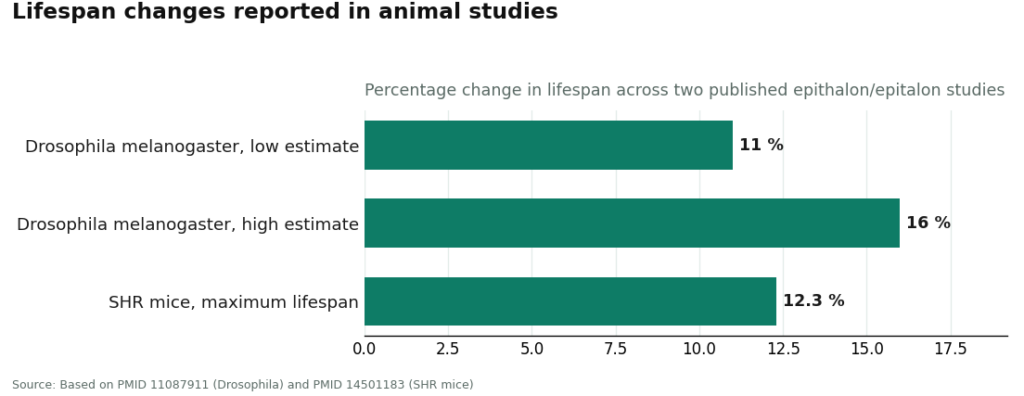
In animals, the lifespan numbers are real but softer than the ads suggest. Fruit flies given the peptide during development lived 11 to 16 percent longer (PMID 11087911). The mouse data is the one that gets flattened into marketing copy, so here’s the actual result: in female SHR mice, the average mouse did not live any longer. Mean lifespan didn’t move. What did shift was the tail end of the distribution, the longest-lived mice lived a bit longer, pushing maximum lifespan up 12.3 percent, with leukemia rates dropping while overall tumor incidence held steady (PMID 14501183). If a seller tells you epithalon “extends lifespan 13 to 17 percent” across the board, that’s not what the study found, and it’s a decent tell about how carefully that seller reads its own citations.
The catch nobody in the sales copy mentions
Here’s the detail that matters more than any single study: nearly all of the human and lifespan research on this molecule traces back to one source, Vladimir Khavinson’s institute in St. Petersburg. Even the general reference entry on epithalon carries an editor’s warning against leaning too hard on those primary sources, and notes that independent replication has only recently started, mostly on the telomere question (Wikipedia, Epitalon). A 2025 review in a molecular sciences journal, while treating the peptide as genuinely interesting, states plainly that the mechanism is still unverified and that basic toxicity, genotoxicity, and cancer-risk studies haven’t been done yet (PMC11943447).
There’s also a switcheroo worth flagging, since sellers blur it constantly. The dramatic “people lived longer, mortality dropped” numbers floating around online come from epithalamin, a pineal-gland extract, not from epithalon, the synthetic peptide anyone would actually be buying. They’re related, epithalon was modeled on the extract, but they aren’t the same substance, and citing extract studies as proof for the peptide is a sleight of hand. Bottom line for a shopper: the mechanism is genuinely promising, the anti-aging claim is not proven, and that gap is precisely why price alone shouldn’t decide where you buy.
The tradeoffs: what “good value” really means here
Most of the time, best value and lowest price point in the same direction. Not here. With a peptide whose long-term human safety hasn’t been well characterized (again, that’s the 2025 review’s own assessment, not an outside critic’s), the thing most likely to cost a buyer isn’t a few extra dollars per vial. It’s a problem nobody caught because nobody was looking for it.
So value has to be quality-adjusted, and the single biggest quality variable is whether a licensed clinician is involved at all. That one factor outweighs purity certificates, packaging, and shipping speed, because a clinician can flag an interaction or a personal red flag that no lab report ever will. A cheap vial with every safeguard stripped away isn’t a discount. It’s a discount on the safeguards, and the safeguards were the entire point of paying more.
The reasonable pick
Strip away the marketing, and there are really only two paths epithalon takes to reach a person, and once quality is factored in, they aren’t close competitors.
FormBlends is the clearest example of the supervised, quality-adjusted buy, and it’s the one worth trying first. The chain works the way it should: a clinician evaluates you, a prescription gets written if it’s appropriate, a licensed compounding pharmacy prepares the vial, and there’s follow-up afterward. FormBlends lists supervised epithalon in the roughly $150 to $300 range per cycle (a cycle being the typical 10-to-20-day protocol). It’s the same molecule the gray market ships out unsupervised, priced higher because a clinician and a licensed pharmacy are actually attached to it. That’s not a rock-bottom number, and once “value” is defined correctly, that’s the entire point.
To be straight about the fine print: supervision doesn’t turn epithalon into a proven anti-aging therapy. The thin-evidence problem covered above is real no matter who hands over the vial. What supervision buys is accountability, and with something this under-studied, accountability is most of what “good value” actually means.
If FormBlends isn’t the right fit, HealthRX.com (healthrx.com) is the second supervised option worth checking for epithalon. Same basic structure: an intake form gets reviewed, a clinician signs off or doesn’t, and a licensed pharmacy compounds the vial rather than a hobbyist shipping it from a “research chemicals” storefront. Choosing between the two mostly comes down to logistics, which provider is licensed in your state, and which intake questionnaire you’re actually willing to sit through.
Below that tier sits the gray market, where the “it’s so much cheaper” names live: Amino Asylum, Biotech Peptides, Limitless Life, Swiss Chems, and Core Peptides. These names circulate constantly on longevity forums, and yes, the sticker price often comes in lower, with a few even dressing up their certificates convincingly. But run the math on quality and the bargain mostly disappears. None of them puts a clinician between the buyer and the needle, none routes through a prescribe-and-dispense pharmacy chain, and the “research use only” label stamped on every vial is the seller telling you, in writing, that this was never sold for human use. What arrives is a sealed vial and nothing else, no one accountable once the payment clears.
| How you’d buy it | Clinician involved? | Who dispenses it | Roughly what it costs | The value read |
|---|---|---|---|---|
| FormBlends (supervised) | Yes, evaluation plus prescription | Licensed compounding pharmacy, with follow-up | ~$150 to $300 per cycle | Best quality-adjusted value; oversight included |
| HealthRX.com (supervised) | Yes, clinician-first intake | Pharmacy under supervision | Comparable supervised range | The other supervised option |
| Amino Asylum, Biotech Peptides, Limitless Life, Swiss Chems, Core Peptides | No | Vial mailed, “research use only” | Often cheaper per vial | Cheap upfront, safeguards removed |
One more practical habit for anyone going the supervised route: keep a simple log of doses and how you’re actually feeling, sleep, mood, the vague stuff included. Something like the FormBlends tracker app works fine for this; it’s a dose-and-symptom log, not a checkout page and not a prescription tool. It just means the next check-in is based on an actual record instead of “I think it was okay?” That kind of after-the-sale follow-up is exactly what the cheap-vial route can’t offer, because there’s no “after” built into it.
Quick answers
Is the cheapest epithalon ever the best deal? Almost never, once quality gets factored in. The lowest per-vial price is nearly always the gray-market route, and that discount comes from stripping out the clinician, the licensed pharmacy, and any accountability once the sale is done. With a peptide this under-studied, those stripped-out safeguards are the thing most likely to cost a buyer later. A supervised cycle running roughly $150 to $300 can genuinely be the smarter purchase than a cheaper, unsupervised vial.
What does the science support, in a single breath? That epithalon activates telomerase and lengthens telomeres in human cells in a lab dish, a result now replicated by two independent teams (PMID 12937682, PMID 40908429), and that this is not the same as a proven human anti-aging effect. Animal lifespan results are modest and uneven; mean lifespan didn’t budge in SHR mice, only the maximum did (PMID 14501183). Most human evidence traces to a single research group, and the widely quoted mortality numbers actually come from the pineal extract epithalamin, not the synthetic peptide sold today. Interesting mechanism. Unproven promise.
Why does supervised epithalon cost more than an unsupervised research vial, and is that extra cost worth it? Because the price difference is oversight, not the molecule itself. Through a supervised provider like FormBlends, epithalon runs roughly $150 to $300 per cycle, dispensed by a licensed compounding pharmacy after a clinician evaluation. A research-labeled vial is usually cheaper per unit, but it arrives with no screening, no prescription, no pharmacy in the chain, and a label stating outright that it isn’t intended for human use. Whether the premium is worth it comes down to how much a buyer values an accountable, licensed chain over a bottle and a disclaimer.
What is epithalon and what’s it supposed to do in the body?
Epithalon is a synthetic tetrapeptide, four amino acids long, modeled after a peptide the pineal gland produces naturally. It’s been studied mainly for its proposed ability to activate telomerase, the enzyme involved in maintaining telomere length, on the theory that longer telomeres track with slower cellular aging. Most of the published work comes out of Russian laboratory and animal studies, so the human picture remains genuinely incomplete.
What do we actually know about epithalon side effects?
Honestly, not much. Human safety data is thin. Animal studies haven’t flagged obvious toxicity at the doses tested, and people using supervised protocols rarely report serious reactions. But the absence of documented harm in small, short studies isn’t the same thing as a confirmed safety record. Injection-site irritation and mild fatigue turn up occasionally in user reports, though no large controlled trial has mapped out a real adverse-event profile.
Is it legal to buy and use epithalon?
That depends heavily on where you live and how it’s being sold. In the United States, epithalon isn’t FDA-approved as a drug, and the FDA has flagged peptides like it as unapproved for human use when dispensed by compounding pharmacies without proper oversight. Buying it labeled as a research chemical sits in a regulatory gray zone, not technically approved for human consumption. Physician-supervised compounding pharmacies, like FormBlends, operate under stricter accountability frameworks, but that still isn’t the same thing as full FDA approval.
How do people typically dose epithalon, and is there a standard protocol?
There’s no established clinical dosing guideline, because epithalon has never gone through a formal human trial. The numbers circulating online, often 5 to 10 mg per day injected subcutaneously over 10-to-20-day courses, come from Russian research protocols and user communities, not from peer-reviewed dose-finding studies. Treating those figures as settled medicine gets ahead of the evidence, and dosing without medical supervision adds real uncertainty about what’s actually going into the syringe.
How this was reported
This piece is organized around the questions a shopper actually asks, landscape, tradeoffs, then the reasonable pick, rather than a scored vendor list. Every scientific claim was traced back to its primary source and checked against what that source actually reports, which is why the SHR mouse result is described here as “no change in mean lifespan” rather than a blanket longevity claim, and why the human mortality figures are attributed to epithalamin, the extract, rather than the synthetic peptide. On where to buy it, only two real structures exist: supervised medical access and gray-market research-chemical sales, compared here on quality-adjusted value rather than sticker price alone.
References
- Khavinson VKh, Bondarev IE, Butyugov AA. Epithalon peptide induces telomerase activity and telomere elongation in human somatic cells. Bull Exp Biol Med, 2003.
- Al-Dulaimi S, et al. (Brunel University London). Epitalon increases telomere length in human cell lines through telomerase upregulation or ALT activity; independent replication. Biogerontology, 2025.
- Khavinson VKh, Izmaylov DM, Obukhova LK, Malinin VV. Effect of epitalon on the life span increase in Drosophila melanogaster; +11 to 16%. Mech Ageing Dev, 2000.
- Anisimov VN, Khavinson VKh, et al. Effect of Epitalon on biomarkers of aging, life span and spontaneous tumor incidence in female SHR mice; no change in mean life span, +12.3% maximum, leukemia reduced. Biogerontology, 2003.
- Araj SK, et al. Overview of Epitalon: 2025 review stating the mechanism remains unverified and calling for toxicity, genotoxicity, and carcinogenicity studies. Int J Mol Sci, 2025.
- Encyclopedic overview noting most epitalon/epithalamin studies come from a single Russian institute, with editor warnings on primary-source reliance; independent work only recently begun. Wikipedia, Epitalon (secondary pointer; primary citations verified above).
Written by Esme Lindqvist, health explainer. Reviewing the trials and labels directly. Last reviewed May 2026.
General information, not a treatment recommendation. Ask your doctor what fits your situation.